Well, that was weird. As of 11:00 a.m. today, the building administrator had no interest in taking down the white shirts. As you already know, I went ahead with my plan to put on a display of orange shirts.
At, maybe, 2:00 today I received word that the t-shirt exhibit was coming down. Out of the blue. The County had a change of heart because the “handful” of cases that could go to trial next week. That is about the lamest excuse I’ve ever heard- there were more than a handful that could have gone to trial over the last 3 weeks. I won’t really comment much more on that though. I think the County has finally decided to do the right thing, and I am thankful for that. Better late than before I get to put up Orange Shirts, right? I’ve also decided to withdraw my request for a permit to hang the Orange Shirt Project.
On that note, somebody asked me if I this is a win. I don’t see it like that. It wasn’t “us v. them” or any such competition. They wanted to put up the shirts, and were forced to take them down. I got them taken down, but only after they were up for three weeks.
It’s a messed up situation that I’m hoping is never repeated. Not at the courthouse, anyway. If it is, though, I’ve already got some ideas in mind…
It’s been a week since I sent a letter to McHenry County officials. The issue of the shirts was on the agenda for yesterday’s meeting among building administrators. I don’t know what happened. All I know is that the shirts are still up.
As promised, I have applied for a permit to put up something I’m calling the “Orange Shirt Project.” The language in my permit was “inspired” by that for the current t-shirt display. And by “inspired” I really mean that it copies their permit… nearly word-for-word. I don’t see how it can be denied. My permit requests permission to begin the display on 12/1. This should give me time to get it all organized.
Jail is not a joke. This is not a joke. Justice is not a joke. So, I’m looking for some help. I need to hear from those people whose lives have been negatively impacted by bogus allegations of wrongdoing. Maybe you were arrested for a domestic battery you did not commit? Did you ever get kicked out of your house by an order-of-protection based on lies?
I want to hear from you. This stuff happens all the time. Here is our opportunity to “educate” the public.
My goal would be to provide several of you with an opportunity to put a “human face” on the problem of being wrongfully accused. I can provide orange shirts (matching the orange shirts given to McHenry County inmates) and a sharpie to design the shirt. Your shirt will not display your name or anything that might identify you. It will only have your message. The message you think the world needs to hear.
I do not want people with current cases pending. I think it is impossibly unfair that the shirts hanging now may have been made by witnesses on pending cases (we do not know). It would be just as unfair for us to do the same. So, we will not.
If you might be interested, please send me an email (matt@haiduklaw.com). I think we can put together a moving, educational display. Let me know if you would like to help.
At lunch on Thursday, I penned a little letter. I did something my girlfriend says I need to do more- I talked about my feelings
Sometimes I can’t help myself. Sometimes I can’t take it anymore. This is one of those.
October is, apparently, domestic violence awareness month. Or something like that. Every year the Woodstock courthouse celebrates this with a display of shirts. Not any shirts, though. White shirts that are “decorated” for domestic violence awareness month. And, by “decorated” I mean that very personal, powerful, direct statements are written on them. Some in Spanish. Some with illustrations.
They say things like, “violence is not just physical.” They address “you.” Many of them tell powerful stories. The display certainly does meet its goal of giving a “voice” to victims of domestic abuse.
And all of them are suspended from clotheslines spanning 3 stories of open stairway. The same stairways that jurors walk up. The same stairways that the criminally accused walk up. The same stairways that I walk up.
I have had enough.
It’s not fair.
It is not fair that purportedly neutral jurors should be subjected to a display that is aimed at essentially telling “us” that “we” do not understand how serious a problem domestic violence is. “We” don’t get how it is underreported. “We” don’t get how “abusers” get off easily.
I don’t think it’s fair. Not sure what to do, I contemplated my options. Should I subpoena the names of every person who made a shirt? I mean, I think the confrontation clause would give me a right to ensure none of them are witnesses against my client. Witnesses should not be able to “talk” to jurors (even indirectly) without my cross examining them, right?
That seemed a little harsh. I mean, getting these shirts taken down should be easy, right? So, I set out to do things the “easy” way. At lunch on Thursday, I penned a little letter. I did something my girlfriend says I need to do more- I talked about my feelings.( click link for copy of letter). I told them how I felt about the shirts. It was direct. Maybe a little too direct for some people’s taste. I asked around the courthouse and was told that I should direct it to the Trial Court Administrator.
Friday afternoon, I got a response from the Trial Court Administrator. Guess what? The trial court administrator is not in charge of making sure judicially prejudicial stuff isn’t hanging over the stairs. I guess the county building administrator has that job! Thankfully, the Trial Court Administrator forwarded my stuff over.
That was Friday. Guess what was still hanging up today? Yeah. The dirty laundry.
Oddly enough, I was contacted by a newspaper reporter today. I can’t wait to see what their story says. Should be fun to see where this goes tomorrow!
I just came across this page and love what I’ve read so far. Most of the criminal law stuff on the ‘net is fluff and marketing. Are you really getting “case updates” off of blogs instead of official pages? I didn’t think so. This guy is a straight shooter.
http://criminaldefenseblog.blogspot.com/
I don’t know how to set up one of those bookmark things. I’m posting this so that I can always find the link.
If you are free to leave, why would you stay? I wouldn’t. Most people do.
I’ve spent the last couple of days thinking long-and-hard about the way “regular” people deal with the police. I have developed a genuine interest in figuring out why people have no problem questioning any intrusion to their lives… except when it comes to personal dealings with the police. For some reason you will go to great lengths to keep Wal-Mart out of the other side of your town but you have no problem letting the police in your car? I don’t get it. I think I’ve made it plenty clear that how you interact with the police has nothing to do with being guilty or innocent.
Perplexed as I may be, I’ve tried to figure it out. My hunch is that it has to do with the early perception children form of the police. Children are taught, rightly so, that the police help us when we need it. Approached by a stranger? Find the police. Bad car accident on the road? The police show up to help. With D.A.R.E. programs and school liaison officers becoming commonplace, it’s only natural to develop an affinity towards the helpful police. Maybe, then, people don’t want to disappoint people they see as potentially helpful to someone? I’m not sure.
Before I get any more nasty email, I’m not knocking the police. They can’t believe the things people willingly do, either. Don’t believe me? Ask a cop. The police know that most people will let them do whatever they’d like, and those police will use it to their advantage. They are the educated ones.
On that note, today I offer a little counter-education. There are three things that people hardly ever say to the police. Three powerful things. Three things rooted in the Bill of Rights. Three things that may not be specifically mentioned, but that James Madison would want you to know.
Three things you can say (that the police really don’t expect to hear):
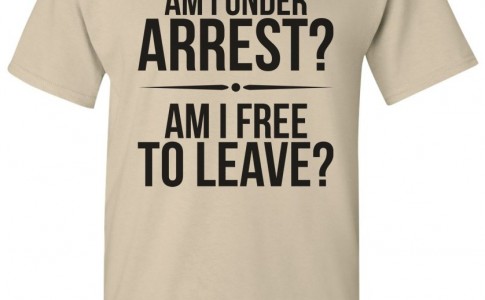
1. “Am I free to leave?”
Without getting into a very long legal explanation, this simple question may help trigger a lot of legal issues. If you are not free to leave, your interaction with the police is not “consensual”. It may not be a full-on arrest, but it is not consensual. If you are ever unsure, ask. Don’t be surprised if you get an indirect or incomplete answer back, though. Police don’t get asked this very often, and it can actually be a difficult question to answer from their end. Also, they may be worried that you will leave. Insist on clarification, though. If you are not free to leave, you need to know.
Which brings up another question that torments me. If you are free to leave, why would you stay? I wouldn’t. Most people do.
2. “I would like to speak with an attorney before I talk to you.” I know what you are thinking. You’re thinking, “I’m never going to get interrogated for murder, so why do I care?” Traffic court is filled with people who thought like this. In court, though, they want their day. People want trials. People don’t believe they were speeding. People know that radar is inaccurate. People aren’t buying that they were clocked at 20 MPH over the limit.
People don’t know, though, that traffic court is filled with magic. I’m not talking slight-of-hand or even Jedi mind-trick magic. I’m talking Carnac magic. Anybody sitting in traffic court for a couple of speeding trials has this magic. I have it. You can get it. It’s the magic that helps us know what the police officer says before he even says it:
Seasoned Officer: “…after the radar readout was 76 in a posted 55 MPH zone, I stopped the vehicle.”
Seasoned Officer: “I approached the vehicle, asked the driver for license and insurance, and asked her if she knew why I pulled her over.”
Incredibly Skilled Prosecutor: “Then what happened?”
Seasoned Officer: “She admit that she was speeding, but said that she was only going 6 miles-per-hour over the speed limit. She said she was going with the flow of traffic, and could not have been going that fast…”
If the judge believes the driver of the vehicle actually said that, everything else at trial is a lot less important. Confessions are the most damning evidence possible. If the driver had, instead, told the officer that she didn’t want to talk about the stop without consulting an attorney first, she would have a better chance at trial. If you’re going to go to trial, why not take your best chance?
I know you think it’s nuts to say this at a traffic stop. I’m o.k. with that. They are your rights… do with them what you want.
3. No. No. Say it with me, “No!” This one can be a little bit tricky. The general rule is that you’re allowed to say “no.” You’d like to take a look around my car? No. Can you ask me a couple questions? No. You’d like to walk through my back yard? No. Can I come down to the police station to talk to you? No. Do I know where Jimmy Hoffa is buried? No, no, no!
“No” is tricky because there are some exceptions. Never use it if using it will be lying. Am I Matthew Haiduk? Saying “no” to that could get me in trouble. “No” can also be over-ridden. You might say they can’t come in, but their warrant says otherwise. What happens when a team of armed police are dressed in tactical gear, knocking on the door, telling you that they have a warrant and you tell them they can’t come in? Well, they’re about to knock down your door and hog-tie you anyway. What you say doesn’t really matter!
There is a very simple way to figure out of you can say “no.” If you are not sure whether or not you can say it, just scrap “no” off the list of things you’ll say to the police. Instead ask if you are free to leave. Then tell the police you would like to talk to your lawyer. It really is that easy.